The United Nations Secretary-General, Antonio Guterres, has called for de-escalation between India and Pakistan, expressing deep concern over rising tensions following a terrorist attack in Jammu and Kashmir. Guterres reiterated his condemnation of the attack and urged both sides to avoid a confrontation, which he described as catastrophic. The Secretary-General has also offered his good offices to support de-escalation efforts. The President of the UN General Assembly, Philemon Yang, has also expressed concern over the escalating violence and called for a resolution through diplomatic means. Meanwhile, Pakistan has denied any involvement in the attack and reiterated its commitment to fighting terrorism.

Days after the Pahalgam terror attack, Jammu and Kashmir authorities have deported 59 Pakistani nationals, including the mother of Shaurya Chakra awardee Constable Mudasir Ahmad Sheikh. The Pakistani nationals were living in the valley for decades and were transported to Punjab for repatriation. However, the mother of the deceased soldier was later allowed to stay back. The deportation comes after the Indian government announced a slew of measures against Pakistan in the wake of the Pahalgam attack, including the suspension of the Indus Waters Treaty and the downgrading of diplomatic relations.
'Pakistan cannot sustain a war with India for more than four days. They are in such dire straits. At best they can sustain war for one week.'
'If there is a military standoff eyeball to eyeball on the western border, the Chinese could create problems by making movements in the north, in our northeast, which could involve us tying down some forces there so that could stretch our military actions.'

The highlight of Tuesday's debate on Operation Sindoor was the speech by Prime Minister Narendra Modi, with the rebuttal by Congress's Wayanad MP Priyanka Gandhi coming a close second.

He said India was planning to build projects on three rivers flowing into Pakistan to use its share of water.

Army spokesman Lt Gen Ahmad Sharif Chaudhry in a media interaction said at least 26 people were killed and 46 injured in the missile strikes on cities in Punjab and PoK. "The six locations that India attacked last night... Pakistan lost 26 people and 46 were injured," he said.
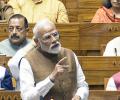
Prime Minister Narendra Modi defended India's actions against terrorism, stating no country stopped India and criticizing the Congress party for not supporting the armed forces. He highlighted the success of Operation Sindoor and warned Pakistan against further misadventures.

Kamal Majidulla, special assistant to the prime minister on water issues, claimed that the neutral expert's verdict of 2007 on the Baglihar project was a "travesty of justice" and an "inversion of the Indus Waters Treaty" that allocated three Western rivers to Pakistan.
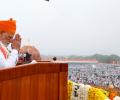
Prime Minister Narendra Modi addressed the nation on Independence Day, focusing on economic growth, self-reliance, and national security. He emphasized manufacturing quality products at affordable prices, supporting farmers, and combating terrorism and infiltration.

In the India-Pakistan situations, off-ramps have come either through foreign mediation (after months of kinetic warfare over Kargil, and a long stand-off with Op Parakram) or when a situation made it possible for both sides to claim a win, explains Shekhar Gupta.
"The design of the project is strictly according to the Indo-Pak water treaty and will not become hurdle in the peace process," Union Water Resources Minister Priya Ranjan Dasmunshi explained.

'Whatever we do, the purpose will be to re-establish deterrence.'

India has accused Pakistan of breaching an understanding reached earlier on Saturday to stop military actions. Foreign Secretary Vikram Misri said there have been repeated violations of the understanding since the evening, and that the Indian armed forces are giving an appropriate response.
Islamabad says the height of the project is in violation of the Indus Waters Treaty.

External Affairs Minister S Jaishankar addresses Parliament on Operation Sindoor, denying any US trade linkage and highlighting Pakistan's request for a ceasefire through the DGMO channel.
With India and Pakistan set for a battle in an international court to settle their dispute over the Jammu and Kashmir-based Kishenganga hydel project, the Indian government has earmarked Rs 30 crore to take care of the legal expenses.

Following a deadly terror attack in Pahalgam, India has ordered all Pakistani nationals to leave the country within 48 hours. This has led to a mass exodus of Pakistani citizens from India, while several women married to Pakistani nationals and holding Indian passports are facing difficulties returning to their families in Pakistan.

The announcement on expansion of CPEC was made following a meeting among Chinese Foreign Minister Wang Yi, his Pakistani counterpart Ishaq Dar and Afghanistan's Acting Foreign Minister Amir Khan Muttaqi in Beijing, according to a Pakistani readout.
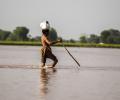
The Express Tribune reported that a post-flood report of the Irrigation and Power Department says India provided misleading information regarding water flows in Rivers Chenab and Jhelum resulted in aggravating damage in 14 districts during floods between September 5 and 17.

In his letter, Qureshi also accused the Indian government of using 'water as a weapon'.

'We've moved from thousands killed yearly in Jammu and Kashmir to 127 last year.' 'Cross-border terrorism in Kashmir is being solved. We are winning it.'
Umer Ayub Khan signs a petition to the World Bank raising a dispute over the Baglihar hydropower project under the Indus Waters Treaty. His grandfather and Nehru had signed the treaty.

The ministry of external affairs also seemed to reject Trump's forceful comments that Washington brokered the understanding between India and Pakistan on ending their four-day military conflict.

Reddy alleged that contracts worth thousands of crores were awarded to people close to Modi, who then purchased Rafale aircraft.
The US may need to develop a closer relationship with Pakistan to deal with Pakistani state-sponsored terrorism, but it should take India into confidence, writes K Subrahmanyam.
Water Resources Minister Saifuddin Soz emphasised that river Jhelum, on which the project is proposed to be built, is a 'symbol of our civilisation' and cannot lose the right of navigation on it.
'The dialogue process is just too inadequate to meet the challenges from Pakistan,' says former R&AW chief A K Verma.
According to Pakistan, India will violate the Indus Water Treaty by constructing a hydropower project on Chenab.
Pakistan had earlier moved the World Bank for appointment of neutral experts but India has insisted on solving the issue bilaterally.
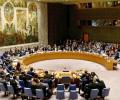
The United Nations Security Council held closed-door consultations on rising tensions between India and Pakistan, with envoys calling for restraint and dialogue. The consultations, requested by Pakistan, lasted for about an hour and a half. UN Secretary-General Antonio Guterres expressed concern over the tensions, urging both countries to avoid a military confrontation. India's former Permanent Representative to the UN, Syed Akbaruddin, said that no consequential outcome could be expected from the discussion.
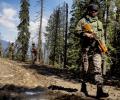
Pakistan has warned the international community that any military moves by India shall be 'responded to assuredly and decisively... onus of any escalatory spiral and its consequences shall squarely lie with India.' Implicit in the statement is a veiled threat that even a nuclear threshold may be reached if push comes to shove, warns Ambassador M K Bhadrakumar.
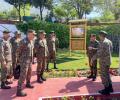
'Surgical strikes or air strikes, or both, are likely on the table.'
According to the provisions of the treaty, the decision of Professor Lafitte on all matters within his competence is final and binding.
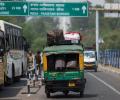
For Ali, who hails from Mendhar sub-division near the Line of Control (LoC) in Poonch district, the uniform is more than a job -- it's a calling. He has dedicated nearly half his life in the police force, serving its various wings with distinction and earning multiple commendations for his courage and unwavering commitment to duty.

A police officer and his eight siblings, including five sisters, were deported to Pakistan on Wednesday despite a court order granting them temporary relief. The nine members of the extended family, who have been living in Jammu and Kashmir for generations, were among more than two dozen people, mostly from Pakistan-occupied Kashmir (PoK), who were served deportation notices following the April 22 Pahalgam terror attack. The deportation has sparked outrage, with protests and appeals for intervention from the home minister and lieutenant governor. The family members claim they are not Pakistani nationals and have been living in the region for generations, presenting revenue records to support their claims. The court has ordered a detailed report on the case within two weeks and will hear it again on May 20.

Asserting that India will not tolerate any 'nuclear blackmail', Prime Minister Narendra Modi on Monday said operations against Pakistan have only been kept in abeyance and the future will depend on their behaviour.
Pakistan claims the project violates the 1960 Indus Water Treaty.
